
Wallpaper Installation and Removal
Walls That Reflect Precision and Personality
Wallpaper Installation in Rutherford County for accent walls, feature spaces, and commercial interiors requiring exact pattern alignment
Total Home Painting & Renovation handles wallpaper installation in Rutherford County for residential and commercial properties where pattern matching, texture coordination, and surface preparation determine how long the installation lasts. Geometric designs, murals, and textured materials like grasscloth or metallic finishes require different adhesion approaches, and walls must be properly smoothed, primed, and sealed before any paper goes up. Without correct preparation, bubbles form within days, seams lift early, and patterns never align the way they should across multiple panels.
Installing wallpaper involves more than unrolling and smoothing—it starts with repairing drywall imperfections, applying sizing to control porosity, and ensuring the substrate is completely level so repeating motifs line up at every seam. Non-woven materials behave differently than vinyl or fabric-backed papers, and each type dictates specific adhesive formulas and drying conditions to prevent edge curling or moisture trapping.
Request a consultation to review surface conditions and discuss pattern options for your project.
What Proper Installation Requires Before Paper Touches Wall
Surface preparation determines whether wallpaper stays flat for years or shows defects within weeks. Walls get inspected for texture inconsistencies, nail pops, joint compound ridges, and any residue from previous finishes that could interfere with adhesion. Smoothing involves sanding high spots, filling low areas, and applying a skim coat when necessary to create a uniform plane. After repairs cure, a primer-sealer goes on to lock out moisture, prevent the wall from absorbing adhesive unevenly, and make future removal cleaner if you decide to change the design later.
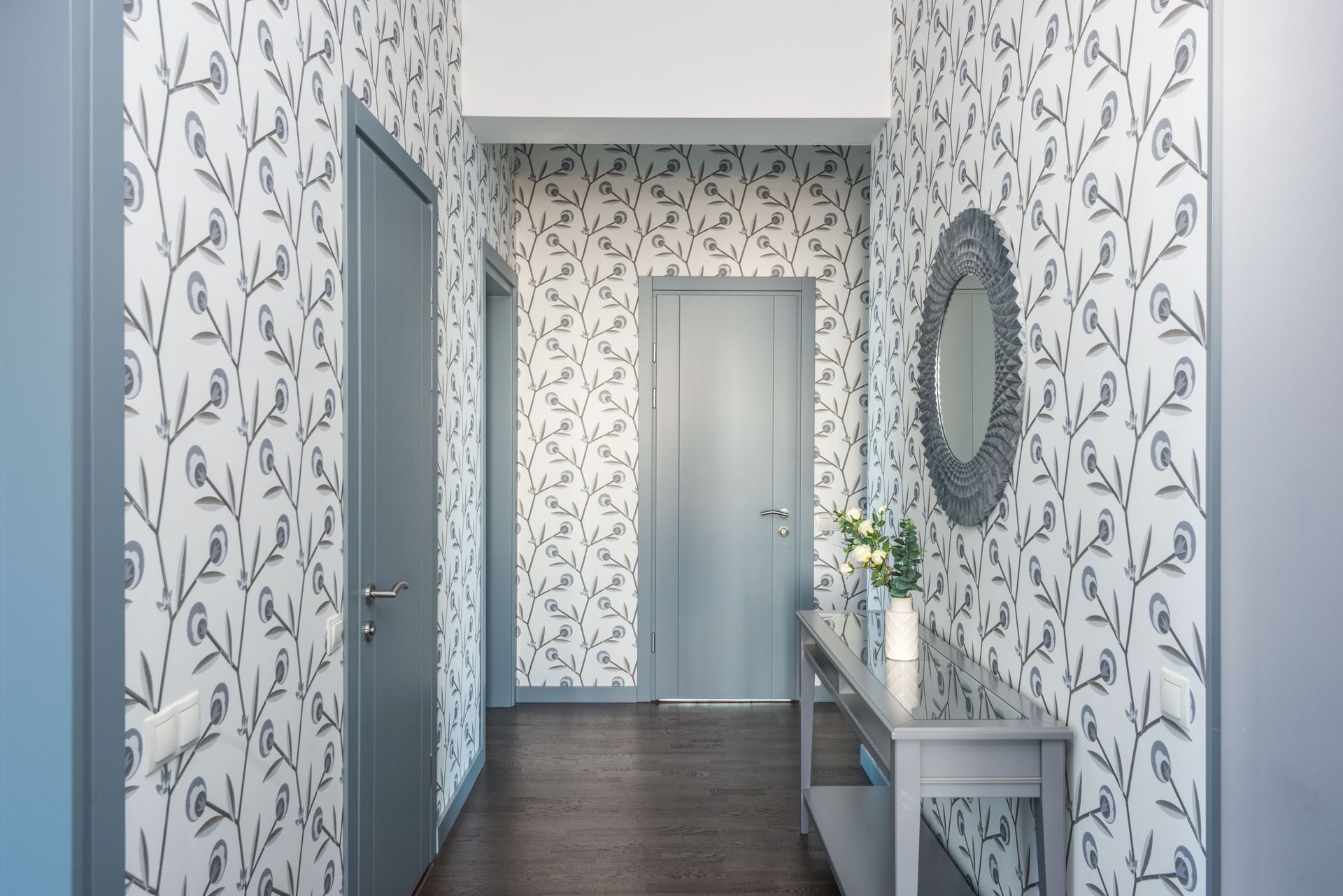
Once installation begins, you'll see precise pattern matching where motifs continue seamlessly across panels, seams that remain tight without overlapping or gapping, and a smooth finish free of air pockets or wrinkles. Textured materials like grasscloth require careful handling to avoid crushing fibers during smoothing, while metallic finishes show every flaw if the substrate underneath isn't perfectly prepared.
Commercial applications in retail boutiques and office feature walls follow the same preparation standards but often involve larger uninterrupted expanses where alignment errors become immediately visible. Residential spaces like powder rooms, dining rooms, and nursery accent walls benefit from custom pattern placement that centers focal points and avoids awkward cuts at corners or ceiling lines.
What Property Owners Usually Ask
Projects vary based on wall condition, material type, and pattern complexity, so these answers address the factors that come up during planning and installation.
What happens if existing walls have texture or previous wallpaper?
The old surface gets removed completely, texture is sanded flat or a skim coat is applied to level it, and then priming ensures the new paper adheres without telegraphing imperfections through the finish.
How does pattern matching work with geometric or mural designs?
Each panel is cut and positioned so motifs align horizontally and vertically at every seam, which requires calculating the repeat distance and adjusting starting points based on ceiling height and wall width to avoid misalignment.
Why does surface preparation take longer than the actual installation?
Repairing drywall, smoothing inconsistencies, and applying primer-sealer correctly prevents adhesion failures, and skipping those steps leads to bubbling, peeling, and premature seam separation that becomes visible within weeks.
What types of wallpaper work best in high-humidity areas?
Vinyl and non-woven materials resist moisture better than paper-backed or fabric options, and proper ventilation in spaces like powder rooms in Rutherford County helps prevent edge lifting during seasonal humidity swings.
How long does installed wallpaper last before needing replacement?
When walls are prepared correctly and materials match the room's conditions, wallpaper stays intact and visually consistent for ten to fifteen years, with seams remaining tight and colors staying true unless exposed to direct sunlight or repeated moisture contact.
Total Home Painting & Renovation applies precision pattern matching and complete surface preparation to every wallpaper installation, whether you're adding a statement wall to a residential space or updating a commercial interior. Schedule an evaluation to review wall conditions and material options for your specific project.